Category Archives: Fathers of the Faith

DEALING WITH MONEY

APOSTOLIC INSIGHT What can the Apostles and Church Fathers tell us about our times? What advice do they have for our problems? Here are some of their thoughts…

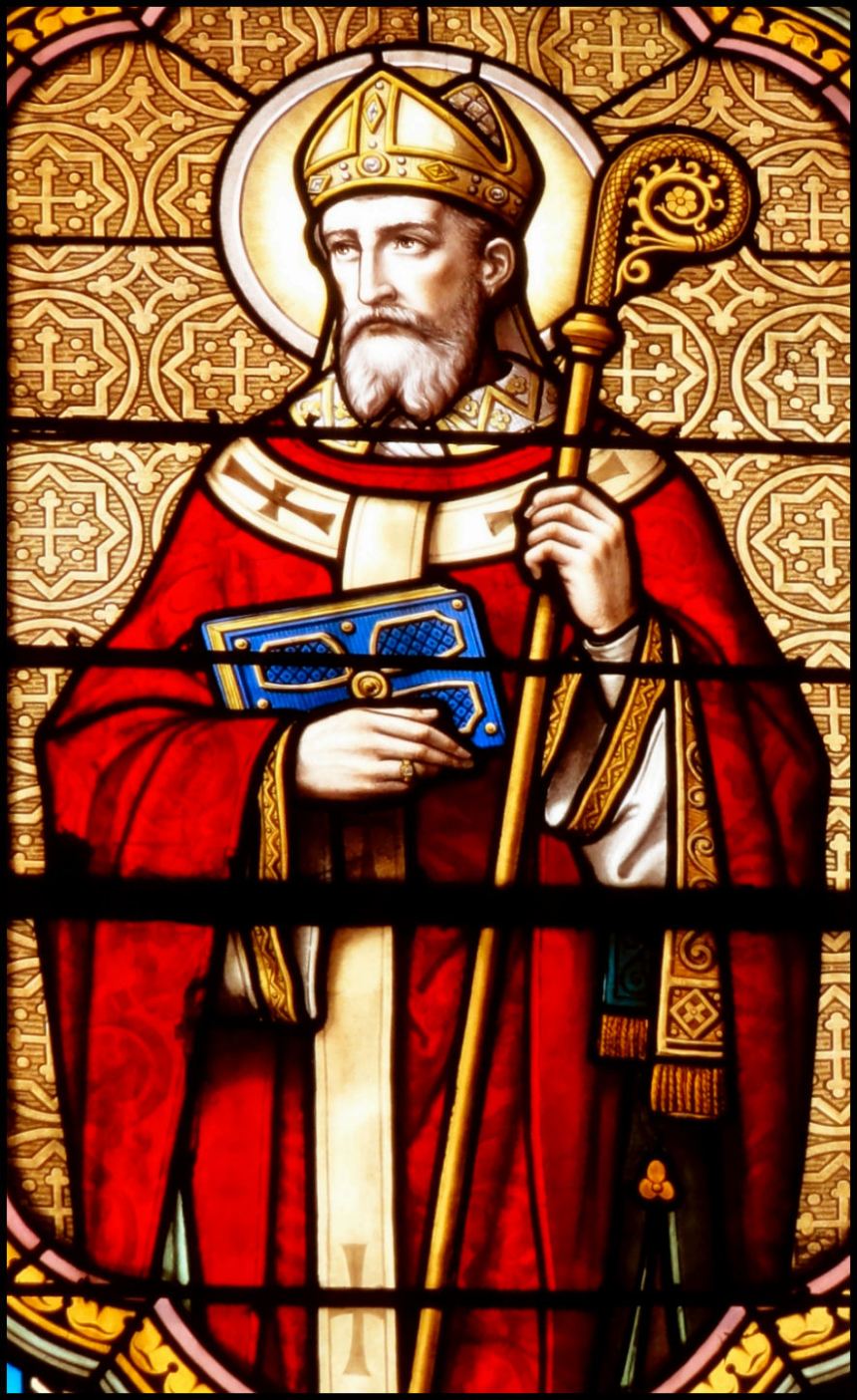
st-ambrose-stained-glass

What did the first Christians think about money and how we should handle our accumulation of wealth? Interestingly enough, the New Testament did not condemn wealth or private possessions. The concern of scripture was having the wrong priorities. Putting our ultimate trust in what we can accumulate was a dead end street. The Parable of the Rich Farmer expressed this mistake (Luke 12:16-21) This parable was telling the listeners that it was more important to be rich in the things of God than only to accumulate wealth. Those that have resources should be concerned about the poor.

Much of the concern of the Church Fathers was because they suspected that great wealth was probably obtained through questionable ways. The bottom line is not riches, but the misuse of money is condemned. The Didache said, “Do not turn away the poor and the needy, but share everything you own with your brothers and do not say that what you have belongs only to you.”

St. Ambrose

The earth was made in common for all. Why do you arrogate to yourselves, your rich, exclusive right to the soil? Nature, which begets all poor, does not know the rich.  For we are neither born with raiment nor are we begotten with gold and silver. … Nature, therefore, knows not how to discriminate when we are born, it knows not how when we die.

Clement of Alexandria

As a further motivation to give, remember that Jesus gave his all to save us. For each of us he gave his life. Because he gave up his life for us, he demands we give our lives for each other.  If we owe our very lives to our brothers, shall we hoard our wealth, and keep it away from them? …. If we do not love our brothers, we are children of the devil and heading for the flames ourselves.  But the true Christian loves his brother!

He who holds possessions as the gifts of God … and knows that what he possesses is for the sake of others is blessed by God and poor in spirit.

St. Basil the Great

Is God unjust to distribute the necessities of life to us unequally? Why are you rich, why is that  one poor? Is it not that you may receive the reward of beneficence and faithful distribution…?

SIMON- THE MYSTERY MAN

WHAT BECAME OF THEM?

By:Archbishop Robert L. Wise… Scripture does not tell us what happened with most of the 11 surviving Apostles. We know about more about St. Paul than almost anyone else. Here’s where you can catch up on their final history.

    So little is known about Simon or the scope of his life that he remains an enigma for today’s world. Depending on the list of the Apostles, he is called Kananaios or Kanaites to distinguish him from Simon Peter. Some versions of the Bible call him the Cananean while other translations refer to him as Simeon the Zealot.

Making the matter even more confusing, some interpret his name to mean that he was a person of great zeal in keeping the Law of Moses and a political activist. Others believe the name means he was part of the radical Zealot party. The Zealots were tax-hating, violent enemies of the Romans. In such case Jesus would have called two men at the opposite end of the political spectrum. Matthew had been a tax collector who the Zealots vowed to kill. If so, there would have been considerable tension between the two men. Unfortunately, no consensus exists on this issue.

While viewpoints differ, some see Simon as possibly a cousin of Jesus or a son of Joseph from a previous marriage. Interestingly enough, Simon was also believed to have been the second Bishop of Jerusalem, after James the brother of Jesus. The Abyssinians maintain Simon suffered crucifixion while the Bishop of Jerusalem. If this is the case, Simon would have probably assumed that position around 68 AD when the first Bishop James (the brother of Jesus) was martyred. Simon would have been in that role as Jerusalem was being destroyed by the Romans.

Again, reports differ, but Simon was reported to have preached in most of the countries of the ancient world, including Britain. In the history of the Parthian Empire, Simon preached in Persia and was martyred at Suamir.  Supposedly, his relics are under the Altar of the Crucifixion in the Vatican. With his relics is a saw because one account has him being sawed into pieces. Sorry, no certainty there either.

Simon remains a figure of legend far more than fact. What we can say of him for certain is that he left everything to follow Jesus. No more accolade there!

The Teaching of the Twelve

When I was a student at Pepperdine University in Heidelberg, Germany, I was faced with the teachings of a bible-based movement, simply called, “the churches of Christ.” Their emphasis was on the “Pattern” of the New Testament church as contained in the Scriptures. Their biblical interpretation was easily enough, “Where the Bible speaks, we speak; and where the Bible is silent, prohibition.”

Needless to say, I was drawn into this hermeneutic for a very long time; that is, until I began to open my mind to the “historical context” of the Bible. You see, historical context has to do with author, time, culture, original audience, political and geographic settings, as well as the occasion for the writings themselves.

I remember clearly. I was a professor and department chair of Psychology, Sociology, and Social Work when a colleague brought to me a copy of the Didache or “Teaching” in Greek. Obviously, extra-biblical litterateur, to be sure, but at that time in my spiritual journey, I was really eager to find an historical context for the things I believed. And, at the time of my discovery, the document was placed well within the First Century. (Later scholars now place it in the early Second Century.)

For me, what caught my eye, was the close proximity the text had to what I had simply knew as the New Testament church

I had long ago concluded that when St. Luke was addressing Theophilus in his book the Acts of the Apostles, he well understood that Theophilus was already engaged in Apostolic worship. To my way of thinking, since Theophilus was already attending, he didn’t require a detailed explanation. But, only an outline, which is clearly what St. Luke provided him: “They devoted themselves to the apostles’ teaching and to fellowship, to the breaking of bread and to prayer” (Acts 2:42, NIV).

This is where this little ancient tome, Didache, comes in–which was also dubbed the “Teaching of the Twelve”.

The first half of this book lays down a kind of code of Christian behavior, which separates two existing life styles: one of life and the other of death. The second half is a manual of Church Order–bingo! Just what I’ve been looking for in order that I might see and understand what Theophilus had already been experiencing.

It shares topics like: baptism, fasting, and the Lord’s Supper and the local ministry of both Bishops and deacons. It in NO way contradicts the Word written, it simply goes into more detail then St. Luke’s narrative allows. Truly fascinating as we wind up with a pattern of Worship which included the Teaching of the Twelve (to include St. Paul, see 1 Corinthians 11:23 [For I received from the Lord what I also passed on to you: The Lord Jesus, on the night he was betrayed, took bread … broke it … NIV]). You see, this is a clear reference to the “Breaking of bread” in St. Luke’s outline to Theophilus.

With this way of thinking, I could go on and on.

My hope, is that you’ll discover this primitive Manuel, Didache, and make your own joyful conclusions. For me, this is not a challenge to the pattern of Worship as found in the book of Acts, but rather a reinforcement of its integrity. Written by Father Michael O’Donnell

Note: Principal Source, Early Christian Fathers, edited by C. C. Richardson, Touchstone, NY, NY, 1996.

Right Relationships

May 14, 2018

love-one-another

Continuing with Polycarp’s letter to the Philippians, he exhorts them to be obedient to “the word of righteousness” as found in the book of Hebrews (5:13). He then goes on to talk about the basis for these righteous or right relationships (with God and others) by referencing key leaders who were exemplars of the word of God.

By referencing Hebrews, Polycarp makes clear that they were to “Remember their leaders, who spoke the word of God to you (“word of righteousness”). [And] consider the outcome of their way of life and imitate their faith” (13:7, NIV).

You see, for Polycarp, the changed life was the only authentic qualifier for authoritative leadership in the body of Christ. Thus, he could commend to them blessed Ignatius and Zosimus and Rufus as having lives worthy of being imitated, because they demonstrated love for God and love for their neighbors. (The Two Greatest Commandments.)

Polycarp, then, rightly concludes that they are to follow these exemplars as these righteous leaders followed the example of the Lord, Jesus Christ. And, Polycarp reminds them, “you have seen with your very eyes” that their lives bear much fruit: “loving the brotherhood”, “cherishing one another”, and “preferring one another”. Thus, to love God and one’s neighbor, is to have “your manner of life above reproach from the heathen.”

This is the Christian message! Whereby, we go from making Jesus our Savior, to making him the Lord of our lives. And, thus allow the world to SEE the real and tangible difference Christ makes in our lives. Polycarp, says, the world will see your “good works” and “the Lord will not be blasphemed. But, rather, be PRAISED! –Michael O’Donnell+

The Church Fathers and US

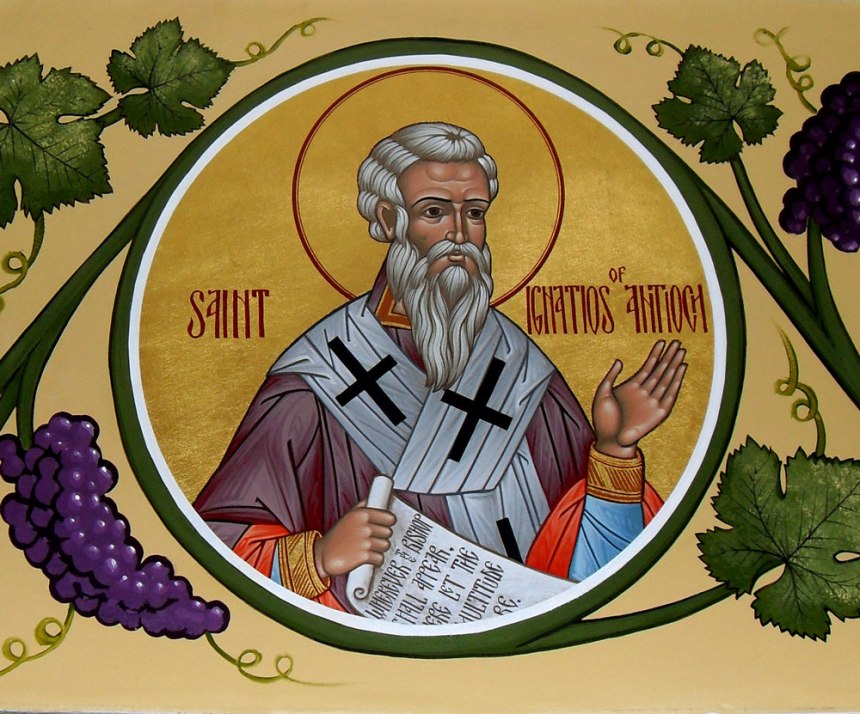
ignatius2

“Be Intentional About Unity”: Still-Relevant Advice from Ignatius of Antioch

In ca. 115 C.E., when he was still a relatively new bishop, Polycarp of Smyrna (died ca. 155/6) received two letters from Ignatius, bishop of Antioch. One was addressed to the entire Christian community at Smyrna (now Izmir, Turkey), the other was a more personal letter containing pastoral advice from the senior bishop to his younger colleague. Both letters were written somewhat in haste from Troas after Ignatius learned that he was to set sail almost immediately to Neapolis (Kavalla, Greece), the port of ancient Philippi (Krenides, Greece).

Ignatius of Antioch

Ignatius had been arrested in Antioch, also known as Antioch-on-the-Orontes and Antioch-in-Syria (modern Antakya, Turkey) and was being taken under guard to Rome. Despite being accompanied by a contingent of 10 soldiers (Ign. Rom. 5.1), Ignatius was able to meet with members of Christian communities along the way, most notably at Smyrna. There he not only met, presumably for the first time, Bishop Polycarp and a number of Smyrnaean Christians, but also bishops, presbyters, and deacons from nearby Tralles (Aydin), Magnesia-ad-Maeandrum (Tekke), and Ephesus (Efes). Among them was a deacon from Ephesus named Burrhus (Ign. Eph. 2.1) who, perhaps as early as in Smyrna, served Ignatius as an amanuensis (scribe), traveling with him at least as far as Troas (Ign. Smyrn. 12.1; Ign. Phld. 11.2).

From Smyrna, Ignatius wrote a letter to each of the three churches which had sent delegations, as well as one to Rome, imploring the Christian community there not to intervene in what he hoped fervently would be his martyrdom (Ign. Rom. 4.2; 5.3; 7.2). From Troas, Ignatius, with the help of Burrhus, wrote to the church at Philadelphia which he had visited prior to arriving at Smyrna and, as noted, wrote also to the Smyrnaean church, as well as to its bishop. It is clear from Ignatius’s letter to Polycarp that he was extremely impressed with the younger bishop. Ignatius not only wishes Polycarp well but, taking on the role of mentor, gives him a great deal of pastoral advice. Perhaps the most important advice comes in the opening paragraph: “Be intentional about unity, for there is nothing better” (Ign. Polyc. 1.2).

Christian Unity

Unity is a recurring theme in Ignatius’s letters. He calls on his readers, with “the voice of God,” to “love unity” and to “shun divisions” (Ign. Phld. 7.1–2). He even describes himself as a man “perfectly fitted to provide guidance for unity” (Ign. Phld. 8.1). One wonders what had occurred exactly in Antioch that had caused Ignatius both to experience the pain of a divided Christian community and to come up with a way to ensure intra-church unity in the future. Reading between the lines, there appears to have been conflict in Antioch over two main issues. The first was the extent to which Jewish traditions and practices should remain part of Christianity (e.g., Ign. Magn. 9.1). The second, and probably the more important, was what Christians should believe about the full humanity of Jesus. Apparently “false teachers” had come promoting the view that Jesus, the divine Son of God, had only “appeared” to have a physical body (e.g. Ign. Trall. 10.1; Ign. Smyrn. 1–8). Ignatius learned from Onesimus, the bishop of Ephesus who met with him at Smyrna (Ign. Eph. 1.3, 2.1), that similar itinerant “Docetists” (from the Greek dokein: “to seem” or “to appear”) had come to Ephesus but had not found a hearing there (Ign. Eph. 6.2, 7.1–2, 9.1). Nor, apparently had Docetism taken hold in the other Christian communities which Ignatius visited or to which he wrote. He implored his audiences, however, to be ever vigilant against “seemingly trustworthy wolves” (Ign. Phld. 2.2; cf. Ign. Eph. 7.1; Ign. Trall. 7.1; Ign. Smyrn. 6.2; Ign. Polyc. 3.1).

Sound Advice

Ignatius’s own practical advice for ensuring unity of faith and practice was to stipulate that everything within the Christian community be done in concert with the will and authority of the bishop. He tells the Smyrnaeans:

Shun division as the origin of (all) evils. You must follow the bishop as Jesus Christ followed the Father, and follow members of the council of presbyters as if they were the Apostles. Regard the deacons as the command of God. Let no one do anything pertaining to the church apart from the bishop. Only that Eucharist is valid which is administered either by the bishop or by someone to whom he has entrusted it. Wherever the bishop is present there is the congregation, just as wherever Jesus Christ is there is the universal (catholic) church. It is not permitted either to baptize or to hold a love-feast (agape) apart from the bishop. (Ign. Smyrn. 7.2–8.2).

And, on the assumption that even his personal letter to Polycarp will be read to the whole Christian community, Ignatius reinforces the point by including in that letter the admonition: “Give heed to the bishop so that God will give heed to you” (Ign. Polyc. 6.1).

The Docetists, Ignatius tells the Smyrnaeans, “abstain from the Eucharist . . . as they do not confess that the Eucharist is the flesh of our savior Jesus Christ” (Ign. Smyrn. 7.1). Perhaps they celebrated a non-Eucharistic “love-feast.” In any case, Ignatius warns, any such meals without the bishop are dangerous, potentially schismatic if not heretical affairs.

According to Ignatius, the bishop is both the symbol and facilitator of Christian unity. His presence, or at least his permission, legitimates authentic Christian faith and practice and guards against division and disunity. Only when the whole Christian community, is paying heed to the bishop can Christian unity be assured (Ign. Smyrn. 8.1–9.2).

Not everyone at the time shared Ignatius’s vision of Christian unity centered on the person and role of the bishop. Even in Rome, it took almost another eighty years for the kind of “monarchical episcopacy” which Ignatius advocated to begin to emerge under Victor (bishop ca. 189–ca. 198/9). The importance of the person and role of the bishop to Christian unity, however, must not be underestimated nor neglected in contemporary ecumenical discussions. Even in churches which do not have an episcopal structure of governance, the unity of the particular congregation, denomination, or world-wide Communion depends on the faithful exercise of the “episcopal” or “episcopacy-like” functions of those authorized (by whatever name or title) to exercise such functions. They are “guardians of the faith;” “shepherds of the flock;” and “celebrants of the sacraments.” In other words, whether or not this is fully understood and appreciated, episkopē (the role and function of ecclesiastical oversight) exists in all churches and should be exercised responsibly even when there are no church officials actually called episkopoi (bishops).

It must also be remembered that at the time of Ignatius and Polycarp the term “bishop” was only barely beginning to be distinguished from the term “presbyter” and applied to the “overseer” of a local congregation not of a diocese. Contemporary ecumenical discussions about Ignatius’s insights regarding the role of the “bishop” as embodying and facilitating Christian unity are, therefore, very much applicable to the local congregation. Indeed, Ignatius’s model, in its historical context, applied specifically to intra-church, rather than inter-church unity. Of course, as, over time, the role of bishop evolved from that of local episkopos to that of the “overseer” of multiple Christian communities in a metropolis or even wider geographic areas, Ignatius’s insights became just as applicable to and remain so for “Dioceses,” “Synods,” “Presbyteries,” “Conferences,” “Regions,” and other ecclesiastical structures—regardless of the title of the particular judicatory’s official “Head of Communion.”

It is as important as ever, if not more so, for all “bishops” in their exercise of episkopē to “be intentional about unity”—as “there is nothing better.” The rest of us Christians are called upon to take Ignatius’s sound advice to heart also and to follow and heed our (congregational or diocesan) bishops as they carry out their God-given “oversight” of Christian faith and practice. Now, as in the time of Ignatius, Christian unity depends on it.

Contributor — Rev. Dr. William Tabbernee

« Older Entries Recent Entries »